Plus/minus blocking system: a new way of looking at the run game
RBs cannot live on goal line carries alone...they must have breakaways

To borrow a phrase from Dollar Bill Stern from Billions: I’m back, baby!
I’ve been away from this Substack for a time, but it’s been for a good reason – to complete work on a brand-new run game breakdown system. We’ll get into some of the details of that system momentarily, but it’s best to begin by telling a quick tale of how this system was developed.
Creating a new system
A few months after my ESPN contract ended in October 2019, I decided to research new ways to break down the rushing game. The initial expectation is this would take a short time, but in the end, it required investing hundreds of hours each offseason learning as much as possible about the ground attack.
This included reading dozens of coaching books, taking dozens of coaching classes, watching countless YouTube videos and spending hundreds of hours breaking down coaching films.
Each year led to a greater understanding, but I was waiting for a Joe Namath-like epiphany. Namath once said that he worked hard to learn the complexities of pro zone coverages and was making continual progress, but it just wasn’t fully clicking. He then woke up one morning and realized that he understood all the things the coaches were trying to teach him.
That epiphany occurred for me in late May 2025. It was a great feeling, but since it was so close to the 2025 season, it meant that a full research project could not begin until 2026.
That project commenced in February 2026 and really started moving forward in March after I spent a few weeks refining the run game breakdown system. Once it was ready to go, it took four months (and roughly 1,000 hours of work) to complete the 2025 breakdowns. Now that they are finished, I’ve got a ton of interesting insights to share with you in the run up to the season.
To kick this off, let’s start with some of this system’s fundamentals.
The basics of the plus/minus blocking system
My original run block grading system, which dates back over 20 years ago, broke planned rush plays down into two categories – bad blocking (defined as when the defense does something to disrupt a rush attempt) and good blocking (when the defense does not disrupt a rush attempt).
About ten years ago, I added the obstruction category. This is when the defense does something to slow a rush play but doesn’t do quite enough to disrupt it. Obstructions account for only about 2-3 percent of planned rushes.
This year’s system greatly expands on this base by framing blocking from a plus/minus perspective. Let’s start with the plus metrics, which are broken down into three categories.
The first is good blocking, which retains the same definition as before.
This second category is excellent blocking. This is when the offense prevents any defensive disruptions and creates additional rushing space for the ball carrier.
The third is breakaway blocking. This starts with the no disruption and additional rushing space parameters, but the additional space is sufficient to provide the ball carrier with a potential breakaway opportunity. A notable item here is that a play cannot be graded as a breakaway if it starts inside the opponent’s 10-yard line.
The minus side retains the bad and obstruction categories and adds the wrecked blocking category. Wrecked blocking is a disruption that prevents the rushing play from even reaching the point of proper execution (e.g., a defensive lineman beats a block and gets to the running back right after the handoff).
Keep in mind that these are not results-based metrics. For example, there are potential breakaway rushes that end up as 6-yard gains due to things like a running back tripping, or wrecked plays that result in 60-yard gains because the running back broke a bunch of tackles.
Fantasy football impact
This system has obvious value in the fantasy football world. Let’s start with the fact that breakaway rushing accounted for 31.1 percent of fantasy scoring value. That’s nearly as much as the percentages posted by good (23.6) and excellent (13.2) blocking combined.
This is surprising considering that any plus blocking play inside the 10-yard line is by definition either good or excellent, so most rushing touchdowns on planned plays (236 out of 346) occur on these types of blocking.
This stat nugget goes contrary to the idea that goal line value is the most important trait for a running back and instead shows that breakaway ability should be touted just as much.
To illustrate how this can impact fantasy football valuations, here is a ranked list of the breakaway yards per carry (YPC) totals for all qualifying running backs in the 2025 season (min 100 planned rush attempts).
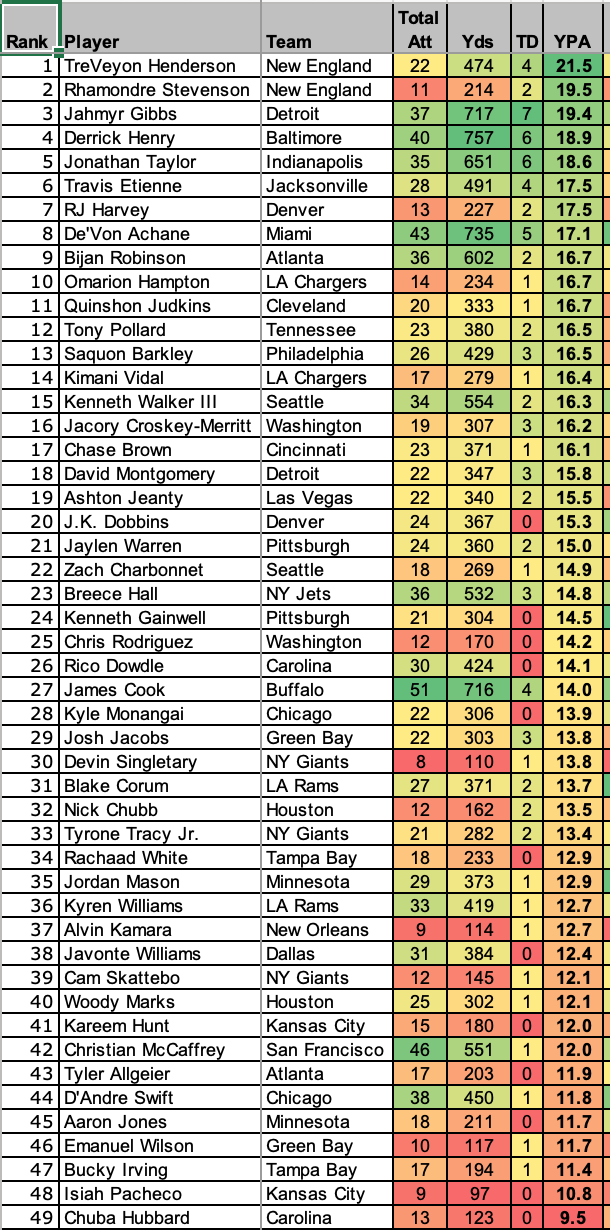
(Note: The full set of plus/minus blocking metrics for the qualifying backs can be found in my 2026 Fantasy Football Draft Guide, which is available at www.TheFootballScientist.com. Use promo code “Substack” to save $5.)
The No. 1 thing that stands out is that TreVeyon Henderson and Rhamondre Stevenson ranked 1-2 in this category. The Patriots ranked 27th in breakaway blocking rate last year, but when they did generate this caliber of blocking, Henderson and Stevenson were both able to destroy defenses. Since New England’s plus blocking rate could move up, both Henderson and Stevenson are rated higher in my draft guide than they are in the fantasy football world in general.
The flip side of that is Chuba Hubbard. He was the only qualifying RB to post a breakaway YPC of less than 10 yards (9.5) and a breakaway fantasy points per play mark of less than one (0.9). Hubbard was also 40th in good YPC and 44th in plus YPC, so this wasn’t limited to breakaway rushes. This is almost certainly why Carolina is motivated to move carries away from Hubbard and to their other RBs. It’s also why Hubbard’s grades in my draft guide are much lower than his consensus fantasy football grades.
Just the beginning
This is just the beginning of the types of reviews I’ll be doing during throughout the preseason and into the 2026 season. Feel free to drop a comment if there are any players or teams that you would like me to review in future posts!